From Renaissance Card Game to Visual Cabinet
The contemporary tarot deck did not emerge from ancient Egyptian temples or mysterious occult cabals. Historical evidence firmly roots its origins in fifteenth-century northern Italy, specifically within Milan, Ferrara, and Bologna, where bespoke decks known as tarocchi served as playful trump games for noble courts. The oldest surviving cards—the Visconti-Sforza decks painted around 1450—reflected Renaissance pageantry, allegorical virtues, and Christian iconography rather than esoteric prophecy.
It was not until late eighteenth-century France, through clergymen and occultists such as Antoine Court de Gébelin and Jean-Baptiste Alliette (Etteilla), that the cards were retrofitted with mystical narratives. Later, the Hermetic Order of the Golden Dawn in Victorian England systematized these symbols by grafting astrological correspondences, Kabbalistic paths, and ceremonial geometry onto the deck. Recognizing this synthetic history liberates modern readers from superstitious awe. The deck is not an ancient relic of absolute fate; it is a meticulously constructed library of human drama.
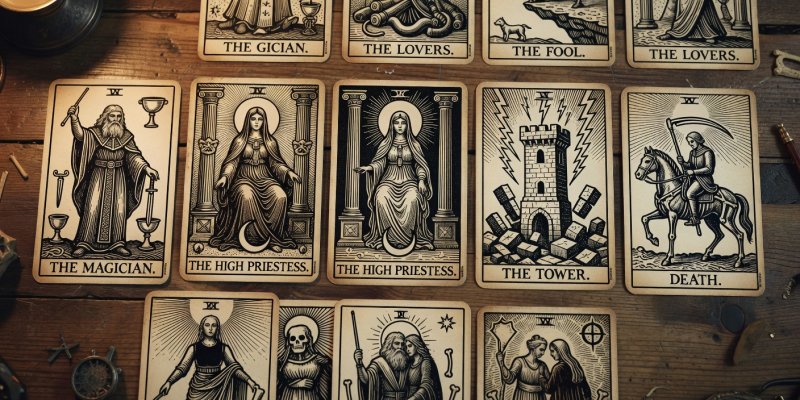
The Dual Architecture: Major and Minor Arcana
A complete tarot deck features seventy-eight cards arranged in two distinct categories. Understanding this dual structure ensures that an inquiry maintains proportional weight, preventing an everyday inconvenience from being mistaken for a cosmic turning point.
The Major Arcana (22 Cards): Numbered from 0 (The Fool) through XXI (The World), these cards depict monumental allegories. In psychological analysis—popularized by Carl Jung’s followers—the sequence mirrors the journey of individuation, tracing the evolution of consciousness from initial naivety through institutional structures, existential shadow, and eventual integration. When a Major card surfaces in reflection, it signals broader life themes, values, and institutional friction.
The Minor Arcana (56 Cards): Arranged into four distinct suits (Wands, Cups, Swords, and Pentacles), the Minor Arcana addresses the mundane terrain of human experience: creative effort, emotional ties, intellectual conflict, and practical resources. Each suit runs from Ace through Ten, capped by four Court Cards (Page, Knight, Queen, King).
| Suit | Element | Core Sphere of Inquiry | Psychological Reflection |
|---|---|---|---|
| Wands | Fire | Ambition, vitality, drive, creative impulse | Where is your energy flowing or meeting resistance? |
| Cups | Water | Affection, grief, intuition, interpersonal bonds | How are subjective feelings shaping current perspectives? |
| Swords | Air | Intellect, clarity, dispute, anxiety, logic | What assumptions, beliefs, or stories cause mental strain? |
| Pentacles | Earth | Work, wealth, physical health, craft, environment | What concrete resources, routines, and physical limits exist? |
Reading Pamela Colman Smith's Visual Cues
The landmark Rider-Waite-Smith (RWS) deck, published in London in 1909, altered tarot permanently because artist Pamela Colman Smith illustrated every Minor Arcana card with narrative figurative scenes. Prior to Smith’s work, pip cards were simple arrangements of symbols (e.g., eight swords arranged geometrically, like playing cards). Smith infused human gestures, postures, and atmospheric weather into every scene.
When analyzing a card, a disciplined reader examines three objective visual layers before forming conclusions:
- Postural Dynamics: Is the figure facing forward into open space, looking back over their shoulder, or turned completely away? Posture denotes openness, avoidance, or nostalgic obsession.
- Atmospheric Palette: Notice the background. Are skies turbulent grey, barren mustard yellow, or calm indigo? Weather indicates internal cognitive climate.
- Symbolic Artifacts: Look at details—blindfolds, flowing streams, stone walls, wilting flora. These concrete elements serve as metaphors for emotional and mental states.
The Essential Rule of the Symbol
A symbol does not transmit an instruction; it sparks a cognitive association. If a card features an enclosed tower breaking in lightning, it does not mean your house will burn down; it asks where rigid, artificial assumptions in your thinking are overdue for sudden dismantling. The authority resides in your capacity for critical self-appraisal.